Maths Is Fun Academy
Making Mathematics Clear, Engaging & Exam-Ready
with SB de GREAT – The Celebrity Teacher
Making Mathematics Clear, Engaging & Exam-Ready
with SB de GREAT – The Celebrity Teacher
Series 1:
The Boy Who Spoke in Stories but Stumbled on Sums
In the vibrant town of Ibadan, where the bustling markets hummed with life and the scent of jollof rice wafted through the air, young Adewale Okonjo thrived as a master storyteller. At Greenfield Secondary School, his classmates gathered eagerly during breaks to hear his tales of legendary Yoruba warriors and football triumphs on the local pitch. Adewale possessed a sharp wit and profound logical reasoning, yet mathematics lessons revealed an invisible barrier. Diagnosed with dyscalculia, a neurological condition impairing number sense, symbolic manipulation, and spatial reasoning, he watched numbers rebel like mischievous spirits in a folktale. Simple additions twisted into chaos, and fractions appeared as elusive as the wind. His teacher, Mr. Chukwuma Eze, a dedicated but traditional educator, often sighed, “Adewale, these are basic operations!” Unbeknownst to him, Adewale exerted immense effort, only for the concepts to slip away like grains of garri through a sieve. This series introduces the quiet struggles that would define his academic path.


Series 2:
The Classroom Labyrinth and Internal Examinations
As internal assessments approached, Adewale’s anxiety mounted like the harmattan winds. In the examination hall, surrounded by the scratching of pens on paper, he excelled in literature and social studies, recounting historical events with eloquence. However, mathematics papers transformed into formidable labyrinths. Equations danced mockingly, and geometry problems felt like navigating Lagos traffic without a map. Despite hours of solitary study under the mango tree in his family compound, his scores languished. One particularly memorable incident saw him confuse multiplication tables during a test, leading to a comical yet heartbreaking array of incorrect answers that amused his friends but deepened his frustration. These early examinations exposed the performance gap caused by dyscalculia, setting the stage for broader challenges.
Series 3:
The Whisper of Adult Legends
During family gatherings in Ibadan, uncles and aunts shared inspiring yet double-edged tales. Uncle Emeka Nwosu, a prosperous trader in Onitsha market, would declare with a hearty laugh, “I never passed mathematics in secondary school—not once! Failed every paper from JSS to SSS. But see me now: I built a thriving business empire. Numbers? I employ accountants for that!” Cousin Funke Adebayo, a successful fashion designer in Lagos, echoed similar stories. These narratives, delivered with warmth and pride, circulated among students like folklore. While motivating in their celebration of resilience, they subtly suggested that mastery of mathematics was not essential for a fulfilling life, planting seeds of diminished urgency in the classroom.
Series 4:
The Ripple Effect on Commitment and Seriousness
Inspired—or rather, lulled—by these adult successes, Adewale’s classmate, Chioma Eze, began to relax her efforts. “Why stress over quadratic equations when Aunty Funke succeeded without them?” she remarked during a group study session. Commitment to mathematics lessons waned across the cohort. Homework submissions became sporadic, extra tutorials were skipped in favor of football or market errands, and revision sessions turned into storytelling circles. This cultural narrative of “making it” despite failures inadvertently affected seriousness, leading to collective underperformance in internal continuous assessments. Adewale, though aware of his dyscalculia, found himself questioning the necessity of relentless practice. The series elaborates on how such stories, though well-intentioned, influenced student mindsets and academic trajectories.
Series 5:
The Looming Shadow of External Examinations
The West African Senior School Certificate Examination (WASSCE) cast a formidable shadow over Greenfield Secondary. For Adewale and his peers, success hinged on balanced aggregates, yet mathematics remained a treacherous hurdle. In mock examinations, humorous mishaps abounded: Adewale once calculated profit and loss as if bartering yams in the market, resulting in wildly imaginative but numerically inaccurate figures. The pressure intensified as families emphasized the exam’s gatekeeping role for university admissions and scholarships. Dyscalculia amplified these stakes, transforming preparation into a test of endurance and ingenuity. Adult tales resurfaced in conversations, further tempering the gravity with which students approached their revisions.
Series 6:
A New Guide Enters the Scene
Hope arrived in the form of Mrs. Adetola Bello, a compassionate counselor trained in learning disabilities. Recognizing Adewale’s dyscalculia during a one-on-one session, she reassured him, “Numbers are not your enemies, Adewale; they simply speak a different dialect. We shall learn their language together through stories and senses.” She introduced multisensory strategies, turning abstract concepts into tangible adventures. This pivotal series details the initial interventions that began reshaping Adewale’s relationship with mathematics.
Series 7:
Multisensory Adventures and Humorous Breakthroughs
Under Mrs. Adetola Bello’s guidance, lessons transformed into engaging escapades. Adewale used colorful beads and market seeds as manipulatives to visualize fractions, imagining them as portions of his grandmother’s legendary pounded yam. He tapped rhythms for multiplication tables, composing jingles that blended highlife music with math facts. Drawing vivid illustrations of algebraic problems—depicting variables as characters in a Yoruba epic—brought laughter and clarity. Peers joined these sessions, turning potential humiliation into communal entertainment. One episode featured Chioma Eze’s dramatic reenactment of geometric angles using her body, lightening the mood while reinforcing concepts. Progress emerged, though challenges persisted.
Series 8:
Balancing Adult Wisdom with Personal Growth
As examinations neared, Adewale reflected deeply on the adult stories. In a heartfelt conversation with Uncle Emeka Nwosu, he learned the fuller truth: success often involved hidden supports and compensations. These dialogues enriched the narrative, illustrating how reframing such tales—celebrating adaptation alongside effort—could restore commitment without diminishing inspiration. Adewale’s improved focus led to incremental victories in internal tests, bolstering his confidence for the external WASSCE.
Series 9:
Triumph in the Examination Halls
The WASSCE unfolded with a mix of tension and resilience. Adewale applied his multisensory toolkit, visualizing problems through stories and manipulatives recalled from practice. While not achieving perfection, he secured a respectable pass in mathematics—sufficient for polytechnic admission in business studies. His aggregate opened doors previously deemed inaccessible. The series culminates in celebratory scenes at home, with family feasts and reflections on the journey, highlighting how targeted support overcame dyscalculia’s impact.
Series 10:
Legacy of the Numerical Odyssey
Years later, Adewale Okonjo emerged as a renowned author and motivational speaker in Nigeria. His book series, Dancing with Numbers, captivated audiences with elaborated tales of his struggles and triumphs. He advocated for greater awareness of dyscalculia in schools, emphasizing multisensory education and nuanced interpretations of success stories. “Many have excelled without mastering mathematics,” he noted in public lectures, “yet with understanding and support, we unlock even greater potentials for our youth.” The odyssey concluded with a powerful message: while adult narratives inspire, they must complement, not undermine, the commitment required for academic and lifelong success.
From the exclusive preserve of:
SB de GREAT (The Celebrity Teacher)
 | Directly proportional: as one amount increases, another amount increases at the same rate. |
| ∝ | The symbol for "directly proportional" is ∝ (Don't confuse it with the symbol for infinity ∞) |
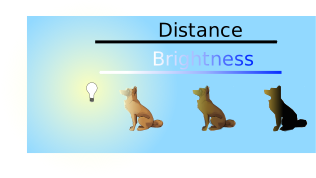
| Inversely Proportional: when one value decreases at the same rate that the other increases. |
|
ITEM №
|
KEY
|
ITEM №
|
KEY
|
ITEM №
|
KEY
|
|
1
|
A
|
21
|
C
|
41
|
C
|
|
2
|
B
|
22
|
C
|
42
|
B
|
|
3
|
B
|
23
|
D
|
43
|
B
|
|
4
|
C
|
24
|
C
|
44
|
C
|
|
5
|
C
|
25
|
D
|
45
|
D
|
|
6
|
B
|
26
|
C
|
46
|
D
|
|
7
|
B
|
27
|
A
|
47
|
C
|
|
8
|
C
|
28
|
C
|
48
|
C
|
|
9
|
C
|
29
|
D
|
49
|
C
|
|
10
|
D
|
30
|
A
|
50
|
D
|
|
11
|
A
|
31
|
C
|
51
|
D
|
|
12
|
B
|
32
|
B
|
52
|
C
|
|
13
|
D
|
33
|
B
|
53
|
A
|
|
14
|
B
|
34
|
C
|
54
|
B
|
|
15
|
D
|
35
|
B
|
55
|
B
|
|
16
|
B
|
36
|
C
|
56
|
C
|
|
17
|
C
|
37
|
D
|
57
|
B
|
|
18
|
A
|
38
|
B
|
58
|
C
|
|
19
|
D
|
39
|
B
|
59
|
D
|
|
20
|
C
|
40
|
D
|
60
|
C
|
|
ITEM №
|
KEY
|
ITEM №
|
KEY
|
ITEM №
|
KEY
|
|
1
|
A
|
21
|
A
|
41
|
C
|
|
2
|
B
|
22
|
A
|
42
|
B
|
|
3
|
C
|
23
|
D
|
43
|
B
|
|
4
|
B
|
24
|
C
|
44
|
A
|
|
5
|
C
|
25
|
C
|
45
|
C
|
|
6
|
A
|
26
|
D
|
46
|
B
|
|
7
|
B
|
27
|
B
|
47
|
C
|
|
8
|
B
|
28
|
C
|
48
|
C
|
|
9
|
C
|
29
|
D
|
49
|
A
|
|
10
|
A
|
30
|
D
|
50
|
A
|
|
11
|
B
|
31
|
B
|
51
|
B
|
|
12
|
B
|
32
|
B
|
52
|
A
|
|
13
|
C
|
33
|
C
|
53
|
C
|
|
14
|
D
|
34
|
D
|
54
|
B
|
|
15
|
A
|
35
|
B
|
55
|
B
|
|
16
|
C
|
36
|
A
|
56
|
C
|
|
17
|
D
|
37
|
C
|
57
|
B
|
|
18
|
A
|
38
|
B
|
58
|
C
|
|
19
|
A
|
39
|
C
|
59
|
C
|
|
20
|
C
|
40
|
C
|
60
|
C
|